866-295-4143, fbns@wayoflife.org
Upon Barack’s election to the presidency, Michelle Obama said, “[F]or the first time in my adult lifetime, I am really proud of of my country” (Feb. 2 0, 2008, to an audience in Milwaukee, Wisconsin). This is in spite of the vast benefits the Obamas personally and multitudes of people in general have enjoyed as American citizens. In spite of its many faults, both historic and present, America is the greatest land of liberty and opportunity and prosperity on earth. America has never had to build fences to keep its citizens in. To this day, multitudes and multitudes around the world aspire to be American citizens. Obama is exhibit A. Twice elected to the U.S. presidency, he has gained wealth and fame, yet he has the gall to speak about victimization and intrinsic racism. It is nonsense; it is crazy; it is hypocrisy.
When he lived in Chicago, Barack Obama chose to be a member of Trinity United Church of Christ, pastored by Jeremiah Wright, a man who preaches a false social gospel and is filled with racial hatred, promoting a stream of lies and half-truths about America’s history and character. He viciously curses America, blames America for 9/11, calls the Supreme Court of Clarence Thomas a “closeted Klan court,” claims America helped put Nelson Mandela in prison for 27 years, invented the HIV virus as a means of genocide against blacks, and supports state terrorism against Palestinians, referring to America’s support of Israel. Though Obama denounced some of Wright’s statements when they were made public and had the potential to harm his candidacy, as a longtime member of Wright’s church he obviously knew of and supported the man’s unscriptural views. In fact, Wright was a member of Obama’s African American Religious Leadership Committee.
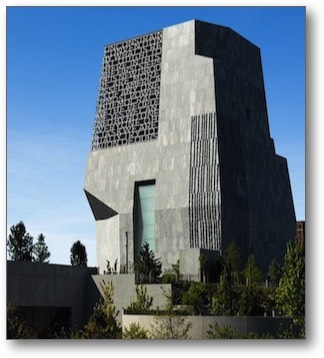
The “fight for justice” promoted at the Obama Presidential Center is not that of Harriet Tubman or Frederick Douglass or George Washington Carver or Sojourner Truth or Booker T. Washington or even Martin Luther King Jr., but it is more along the lines of Malcom X, Stokely Carmichael, Maya Angelou, and Jeremiah Wright.
Consider NINA SIMONE (1933-2003), known as “the High Priestess of Soul,” a folk/blues/ jazz musician and a black power civil rights activist. (Her birth name was Eunice Waymon; Nina Simone was her stage name.) Her music and talks were filled with cursing and bitterness; she fearlessly used God’s name in vain.
Simone is featured in the Obama Center’s Torch Song bronze statue, a monument to Marxist social/economic revolution. The signage says, “Alison Saar’s monumental singer, in blue-green cast bronze, recalls the Statue of Liberty. Holding a flame and wearing piano keys across her shoulders, she honors the powerful Black female voices--from Marian Anderson to Koko Taylor to Nina Simone--who have become the soundtrack of resistance in the fight for justice. Overlooking the Women’s Garden, Torch Song keeps the spirit of progress alight.”
Simone’s influence is large through her music and civil rights activism. Her song “Young, Gifted, and Black” became an anthem for the Civil Rights Movement. She has been the focus of documentaries, movies, dramas, and books, and her music has been covered by many artists and featured in movie soundtracks, television programs, and commercials.
She grew up in Tyron, North Carolina, in the days of segregation, but there was also cordial relations between the races. She wrote in her autobiography: “Blacks and whites took part in all sorts of activities together long before desegregation. People played football constantly, teams from the white schools playing against teams from the black schools. The same for baseball. Black and white church ministers met on an individual basis nearly every day. Each year there would be special church services: one Sunday the congregation of a black church would go to a white church to worship, the next week the white congregation would go to the black church. Relations between the black and white community were always very cordial” (Simone, I Put a Spell on You: the Autobiography).
She grew up in a Methodist home. Both her mother and father were active members. She said, “Life at home was run along very strict rules: there was never liquor in the house, and there was no profanity. A Christian household” (Simone, I Put a Spell on You: the Autobiography). The entire family played instruments and sang in church. Nina showed talent on the piano at age two and a half. With no lessons, the first song she played was the hymn “God Be With You, Till We Meet Again.” She was the regular church pianist by age six. She performed a classical recital at age 12.
Though she was the regular pianist of her family’s Methodist church, a larger influence was her visits to a Holiness church where she fell in love with the “incredible rhythm” that “sounded like it came straight out of Africa.” “When revival time came round they just went crazy.” She played the piano there and learned how to move the congregation with her music. “The preacher would be going, he’d be preaching, he’d be carrying on and everybody’d be going ‘Amen!’ and ‘Yes Lord!’ Then someone would start to testify, shouting and tearing up, speaking in tongues ... people running up and down the aisle--just running back and forth with other people shouting, praising the Lord and the preacher gathering up all that spiritual energy and throwing it back out on the people. Women would have to go to the hospital sometimes, they got so transported. While this was going on I’d be playing the piano, gospel music. The repeated rhythm was part of the process. ... my job was to keep the rhythm repeating, building on it, keeping the feeling going. ... When I played I could take a congregation where I wanted” (Simone, I Put a Spell on You: the Autobiography, pp. 17, 18).
Later, when she was totally in the world, she described how she controlled her audiences with music in secular forums. “It was at this time, in the mid-sixties, that I first began to feel the power and spirituality I could connect with when I played in front of an audience. ... something descends upon you and you are gone, taken away by a spirit that is outside of you. ... when you’ve caught it, when you’ve got the audience hooked, you alway know because it’s like electricity hanging in the air. I began to feel it happening and it seemed to me like mass hypnosis--like I was hypnotizing an entire audience to feel a certain way. ... I had it under my complete control. ... To cast the spell over an audience I would start with a song to create a certain mood which I carried into the next song and then on through into the third, until I created a certain climax of feeling and by then they would be hypnotized. ... I’d got them. It was always an uncanny moment. It was as if there was a power source somewhere that we all plugged into” (Simone, I Put a Spell on You: the Autobiography, pp. 92, 93).
A white lady, a Mrs. Miller, took an interest in Nina at age seven and paid for her music lessons. Her teacher was another white woman, Muriel Massinovith, who “became another mother to me.” Nina was taught classical music in a very disciplined manner and fell in love with Bach. “He is technically perfect. When you play Bach’s music you have to understand that he’s a mathematician and all the notes you play add up to something--they make sense. They always add up to climaxes, like ocean waves getting bigger and bigger until after a while when so many waves have gathered you have a great storm. Each note you play is connected to the next one, and every note has to be executed perfectly or the whole effect is lost” (Simone, I Put a Spell on You: the Autobiography, p. 23).
With the help of caring sponsors, black and white, she continued piano studies and attended Allen High School for Girls in Asheville, North Carolina. Founded in 1887 by white Quaker and Methodist philanthropists who cared for blacks, most of the teachers were white missionaries. By the time of its closing in 1974, the school had graduated 1,177 students, 75% of which went on to attend four-year colleges.
After graduating from Allen, Simone was sponsored to attend the Juilliard School of Music in New York City for a summer and applied to the Curtis Institute of Music in Philadelphia. When not chosen for admission, she believed she was a victim of racism, but only three of the 72 applicants were accepted that year and blacks Blanche Burton Lyles and George Walker had studied at Curtis. Though discouraged, she took private lessons with Vladimir Sokoloff of Curtis and practiced the piano six hours a day for at least 14 years. Eventually, she mixed classical with jazz, blues, folk, black gospel, etc., to create her own style.
Ignoring the advantages she enjoyed personally by being an American citizen, the great blessings she received from American white people, and the historic civil rights progress of blacks in America, and trading the soul-saving, heaven-focused gospel of Jesus Christ for the soul-empty, earth-focused social gospel, Nina Simone became a bitter, angry, morally vile person. She emphasized the victimization mentality that has crippled multitudes of blacks and helped corrupt the black family and black neighborhoods. She had no patience with a gradual, non-violent approach to racial progress. She “supported black nationalism and advocated violent revolution” and “hoped that African Americans could use armed combat to form a separate state” (“Nina Simone,” Wikipedia).
At the 1969 Harlem Cultural Festival, Simone fiercely, angrily shouted to the crowd, “Are you ready to smash White things, to burn things?” (Summer of Soul documentary).
Through the influence of Lorraine Hansberry, Simon was educated in Marxism. She was also close friends with Malcolm X and Stokely Carmichael, head of the Black Panther Party.
When she began playing in bars and night clubs, she changed her name to “Nina Simone” in an attempt to hide her career from her mother and escape her warnings about “the Devil’s music.” “To her that wouldn’t be any different from working in the fires of hell. ... I was out in ‘the world,’ as she called it, and there was no forgiving that unless I repented. ... it was sinful and profane.”
Through the influence of evil communications (1 Corinthians 15:33), she descended into the filthy side of black culture.
Her hit songs included “I Put a Spell on You,” “Little Girl Blue,” “My Baby Just Cares for Me,” “I Loves You, Porgy” (by George Gershwin), and one about Mississippi, the blasphemous title of which we will not repeat. The latter was written in response to the bombing of the 16th Street Baptist Church in Birmingham, Alabama, that killed four black girls, but instead of reacting biblically to this wicked act of racial violence, she reacted in carnal vengeance. Instead of blaming the individuals who committed the deed, she blamed society. Instead of acknowledging the whites that were not racist and those that even died for standing up for blacks, she charged the entire South with racism. She said the song came to her “in a rush of fury, hatred and determination.”
Her philosophy and lifestyle resulted in uncontrolled temper outbursts, disastrous marriages, affairs, lesbian alliances, drunkenness, mental breakdown, and attempted suicide. She forced a vendor at gunpoint to refund a pair of sandals she had already worn and ripped a payphone from its wall. She shot at a record company executive with a gun (she said she wanted to kill him but missed) and shot and wounded a boy with an air gun for disturbing her piano practice. Her daughter Lisa said she was “physically and mentally abusive” and refused to live with her.
Like a large number of “social justice warriors,” Nina Simone could not even keep her own life in good order, not to speak of helping a community or a nation. This type of thing is not righteous and it is not excusable; it is ungodly and it is gross hypocrisy.
- Receive these reports by email
- www.wayoflife.org
______________________
Sharing Policy: Much of our material is available for free, such as the hundreds of articles at the Way of Life web site. Other items we sell to help fund our expensive literature and foreign church planting ministries. Way of Life's content falls into two categories: sharable and non-sharable. Things that we encourage you to share include the audio sermons, O Timothy magazine, FBIS articles, and the free eVideos and free eBooks. You are welcome to make copies of these at your own expense and share them with friends and family. You may also post parts of reports and/or entire reports to websites, blogs, etc as long as you give proper credit (citation). A link to the original report is very much appreciated as the reports are frequently updated and/or expanded. Things we do not want copied and distributed are "Store" items like the Fundamental Baptist Digital Library, print editions of our books, electronic editions of the books that we sell, the videos that we sell, etc. The items have taken years to produce at enormous expense in time and money, and we use the income from sales to help fund the ministry. We trust that your Christian honesty will preserve the integrity of this policy. "For the scripture saith, Thou shalt not muzzle the ox that treadeth out the corn. And, The labourer is worthy of his reward" (1 Timothy 5:18). Questions? support@wayoflife.org
Goal:Distributed by Way of Life Literature Inc., the Fundamental Baptist Information Service is an e-mail posting for Bible-believing Christians. Established in 1974, Way of Life Literature is a fundamental Baptist preaching and publishing ministry based in Bethel Baptist Church, London, Ontario, of which Wilbert Unger is the founding Pastor. Brother Cloud lives in South Asia where he has been a church planting missionary since 1979. Our primary goal with the FBIS is to provide material to assist preachers in the edification and protection of the churches.
Offering: Offerings are welcome if you care to make one. If you have been helped and/or blessed by our material offerings can be mailed or made online with with Visa, Mastercard, Discover, or Paypal. For information see: www.wayoflife.org/about/makeanoffering.html.