866-295-4143, fbns@wayoflife.org
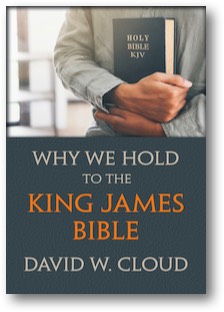
The following is excerpted from Why We Hold to the King James Bible, available at the Books and Courses sections of www.wayoflife.org -
____________
Though seldom acknowledged by historians, the free distribution of the Bible was the most significant influence in England’s era of greatness.
For the first time in its history, the Bible permeated British society in the 16th to 17th centuries and propelled the nation out of the spiritual darkness in which it had long dwelt under Rome’s hand. Protestant Britain has never been a thoroughgoing godly nation, but the Bible had a great influence for good.
In 1525, William Tyndale published the first printed English New Testament and the first translated from Greek.
The Miles Coverdale Bible of 1535 was the first entire English printed Bible.
The Matthews Bible of 1537 was produced by John Rogers, using the pen name Thomas Matthews.
The Geneva Bible was produced in 1560 by refugees from the persecution of Queen Mary. It was a study Bible. The headings across the top of each page told the reader at a glance what book he was reading. Each chapter was preceded by a summary of its content. It contained many notes, explaining the text, teaching Protestant doctrine, and, in some cases, condemning Roman Catholicism. It was the most popular edition of the English Bible prior to the publication of the King James. It was the Bible of America’s first British settlers.
The Bishops Bible of 1568 was produced during the reign of Queen Elizabeth I.
In 1611, the King James Bible was published and soon became the most popular English Bible of all time.
Beginning especially in Tyndale’s day, the English Bible was widely read, propelling the nation out of spiritual darkness.
In about 1537 Thomas Swynnerton observed in his handbook of rhetoric, which was not a religious tract, “Every man hath a Testament in his hand.”
The Tyndale Bible was read aloud to groups large and small, in churches, homes, and public places. Historian John Strype (1643-1737) described the people’s enthusiasm.
“It was wonderful to see with what joy this book of God was received, not only among the learneder sort, but generally all England, over, among all the vulgar and common people; and with what greediness the Word of God was read, and what resort to places where the reading of it was! Every body that could, bought the book, or busily read it, or got others to read it to them, if they could not themselves. Divers more elderly people learned to read on purpose; and even little boys flocked, among the Rest, to hear portions of the Holy Scripture read” (Ecclesiastical Memorials).
The services of the Church of England called for the New Testament to be read through, aloud and in English, three times a year, the Old Testament once, and the Psalms (read or sung) every month. And every citizen was required to attend those services!
This began under Queen Elizabeth I. In the fifty-three articles that she published in 1559, the queen ordered that every church purchase an English Bible and that it be read in services. This was dramatic new thinking for the rulers of England. Only a few years earlier, during the reign of Elizabeth’s father and sister, the Bible was still forbidden and burned. The readers were required to privately read at least two chapters of the Bible daily “to the increase of their knowledge.” No one was allowed to walk in and out of the service during the reading of Scripture or to “be otherways busied.” We follow this wise rule in our church today, not only for Bible reading but also for Bible preaching. When God’s holy Word is being proclaimed, let man be still and take heed! It was also required that children be given biblical instruction.
Consider these descriptions of 17th century England:
“For most men and women the Bible was their point of reference in all their thinking. ... The Bible was the source of virtually all ideas; it supplied the idiom in which men and women discussed them” (Christopher Hill, The English Bible and the Seventeenth-Century Revolution, p. 34).
“[T]he world ruled. In early seventeenth-century England, endlessly and repetitively, the word of God was preached in the 8,000 or so pulpits across England. It was the ocean in which everyone swam. Attendance at sermons was compulsory. Many people would hear two or three on a Sunday in which every last echo of meaning would be squeezed from the words of the Bible. And week after week, preachers would occupy the pulpits, analysing texts, pursuing moral and theological arguments, exercising the difficult and demanding skills that hold a congregation’s attention. They were clearly good at it. Laurence Chaderton, the moderate Puritan leader, once paused after two hours of a Cambridge sermon. The entire congregation stood up and shouted, ‘For God’s sake go on!’ He gave them another hour. There can never have been a time in which Englishmen were so thoroughly drenched in the word. James I used to sleep, it was said, with Lancelot Andrewe’s sermons under his pillow. Andrewes himself could speak for an hour, to an enraptured audience, on the multiple significances of a single word. ... At moments of intensity and crisis, the natural direction a man’s thoughts took ... to the words of scripture from which they had all drawn their sense of reality, their sense of how the world was, for their entire conscious lives. In a sense that almost no one now understands, the words of the Bible were the ultimate and encompassing truth itself. ... The king himself was obsessed with words. He was a book man to his core. ... He was the only person ever to have occupied the English throne to have his works collected--political treatises, designed to guide his sons towards good government, blasts against tobacco and witches, translations of the Psalms, endless theological tracts--bound in a magnificent edition published in 1616. ... England was a kingdom of the word. On the frontispiece to his Workes, James stands beside a table on which there is a book inscribed with the words Verbum Dei” (Adam Nicolson, God’s Secretaries: The Making of the King James Bible, p. 182).
Between 1525 and 1640, printed English Bibles and portions numbered, “at a modest estimate, over two million. ... England had far more Bibles than Germany” (Daniell, The Bible in English, pp. 121, 129). This was for a population of only about six million. In Shakespeare’s lifetime alone (1564-1616), a mere 52 years, a whopping 211 editions of the English Bible and New Testament were published.
In the 18th and 19th centuries, more than 1,200 editions of the English Bible were printed, largely of the KJV.
These figures barely begin to describe the breadth of the Bible’s influence in past centuries, for it is impossible to document the Bible’s influence through preaching and teaching, through printed sermons, through private study and conversations, through quotations in newspapers and magazines and books, and through the publication of Scripture portions.
There was a Cromwell’s Soldier’s Bible for the Commonwealth Army (1645).
A Soldier’s Pocket Bible was printed in large quantities in England and America up to the end of the American Civil War in 1865, containing 150 Bible verses.
Multitudes of commoners were motivated to learn to read by their enthusiasm to study the Bible in their own tongue and were thus lifted out of illiteracy.
“By 1770, shopkeepers were 95% literate. Literacy in England is directly attributable to the Bible” (“The Bible and Written Literacy,” The Washington Times, Dec. 11, 2014).
- Receive these reports by email
- www.wayoflife.org
______________________
Sharing Policy: Much of our material is available for free, such as the hundreds of articles at the Way of Life web site. Other items we sell to help fund our expensive literature and foreign church planting ministries. Way of Life's content falls into two categories: sharable and non-sharable. Things that we encourage you to share include the audio sermons, O Timothy magazine, FBIS articles, and the free eVideos and free eBooks. You are welcome to make copies of these at your own expense and share them with friends and family. You may also post parts of reports and/or entire reports to websites, blogs, etc as long as you give proper credit (citation). A link to the original report is very much appreciated as the reports are frequently updated and/or expanded. Things we do not want copied and distributed are "Store" items like the Fundamental Baptist Digital Library, print editions of our books, electronic editions of the books that we sell, the videos that we sell, etc. The items have taken years to produce at enormous expense in time and money, and we use the income from sales to help fund the ministry. We trust that your Christian honesty will preserve the integrity of this policy. "For the scripture saith, Thou shalt not muzzle the ox that treadeth out the corn. And, The labourer is worthy of his reward" (1 Timothy 5:18). Questions? support@wayoflife.org
Goal:Distributed by Way of Life Literature Inc., the Fundamental Baptist Information Service is an e-mail posting for Bible-believing Christians. Established in 1974, Way of Life Literature is a fundamental Baptist preaching and publishing ministry based in Bethel Baptist Church, London, Ontario, of which Wilbert Unger is the founding Pastor. Brother Cloud lives in South Asia where he has been a church planting missionary since 1979. Our primary goal with the FBIS is to provide material to assist preachers in the edification and protection of the churches.
Offering: Offerings are welcome if you care to make one. If you have been helped and/or blessed by our material offerings can be mailed or made online with with Visa, Mastercard, Discover, or Paypal. For information see: www.wayoflife.org/about/makeanoffering.html.